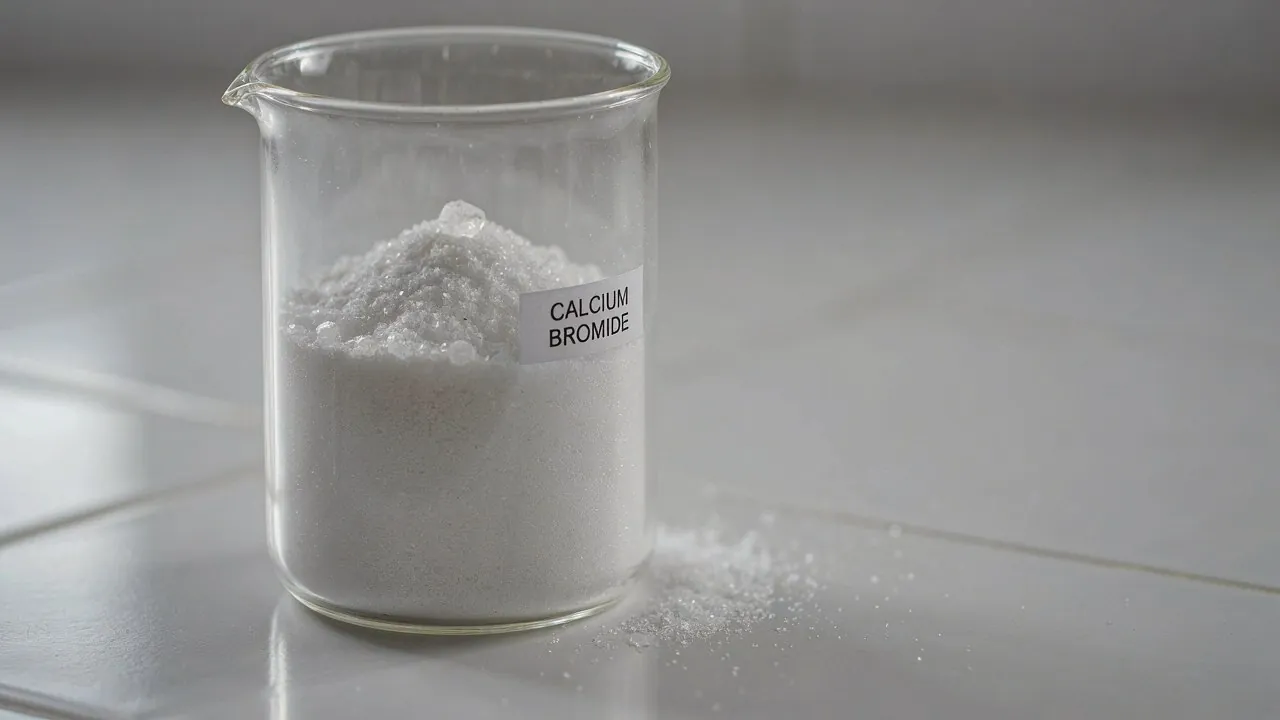
Short answer: pick the lightest, simplest brine that reaches your target density. Sodium bromide covers lighter clear brines, calcium bromide reaches about 1.70 g/cm³ (around 14.2 lb/gal), and zinc bromide blended with calcium bromide reaches the heaviest standard clear brines, about 2.3 g/cm³ (around 19.2 lb/gal). Blends with calcium chloride are often used to reach intermediate densities at lower cost.
Typical maximum densities of clear brines
| Brine | Approx. max density | Typical use |
|---|---|---|
| Potassium chloride (KCl) | ≈ 1.16 g/cm³ (9.7 lb/gal) | Low-density completion, clay inhibition |
| Sodium chloride (NaCl) | ≈ 1.20 g/cm³ (10.0 lb/gal) | Low-density completion and workover |
| Calcium chloride (CaCl₂) | ≈ 1.39 g/cm³ (11.6 lb/gal) | Mid-low density; blending base |
| Sodium bromide (NaBr) | ≈ 1.52 g/cm³ (12.7 lb/gal) | Where calcium is unwanted (e.g. sulphate/carbonate-rich formations) |
| Calcium bromide (CaBr₂) | ≈ 1.70 g/cm³ (14.2 lb/gal) | Mid-to-high density |
| Zinc bromide / calcium bromide blends | up to ≈ 2.30 g/cm³ (19.2 lb/gal) | Highest-density clear brines |
Approximate values at room temperature for guidance only. Actual achievable density depends on temperature, blend and crystallisation limits — always confirm with your fluids engineer and the supplier.
What else decides the choice
- Crystallisation temperature: a brine must not crystallise at the coldest temperature it will see on surface, in risers or in transit. Heavier brines approach their crystallisation limits; blends are formulated to keep a safe margin.
- Formation compatibility: divalent calcium brines can precipitate with sulphate- or carbonate-rich formation water; monovalent sodium bromide avoids this.
- Corrosion and HSE: zinc bromide brines are acidic and corrosive, need careful handling and PPE, and bring stricter environmental controls. Use them only where the density is genuinely needed.
- Cost: cost rises steeply with density. Calcium chloride / calcium bromide blends are often the most economical way to reach intermediate densities.
Solids-free brines and biocide protection
Clear brines are used because they are solids-free and minimise formation damage. Brines stored or recycled for long periods can need a biocide; Bronopol is used for completion-fluid preservation and oilfield injection water.
Supply from India
Kranti Chemicals supplies sodium bromide (25 kg bags, jumbo bags on request), calcium bromide (powder, flakes or brine in drums or ISO tanks) and zinc bromide (powder or brine), technical / oilfield grade, MOQ 2,000 kg, exported from Gujarat with a batch COA. Share your target density, volume and destination for a quote — see our bromine derivatives range.