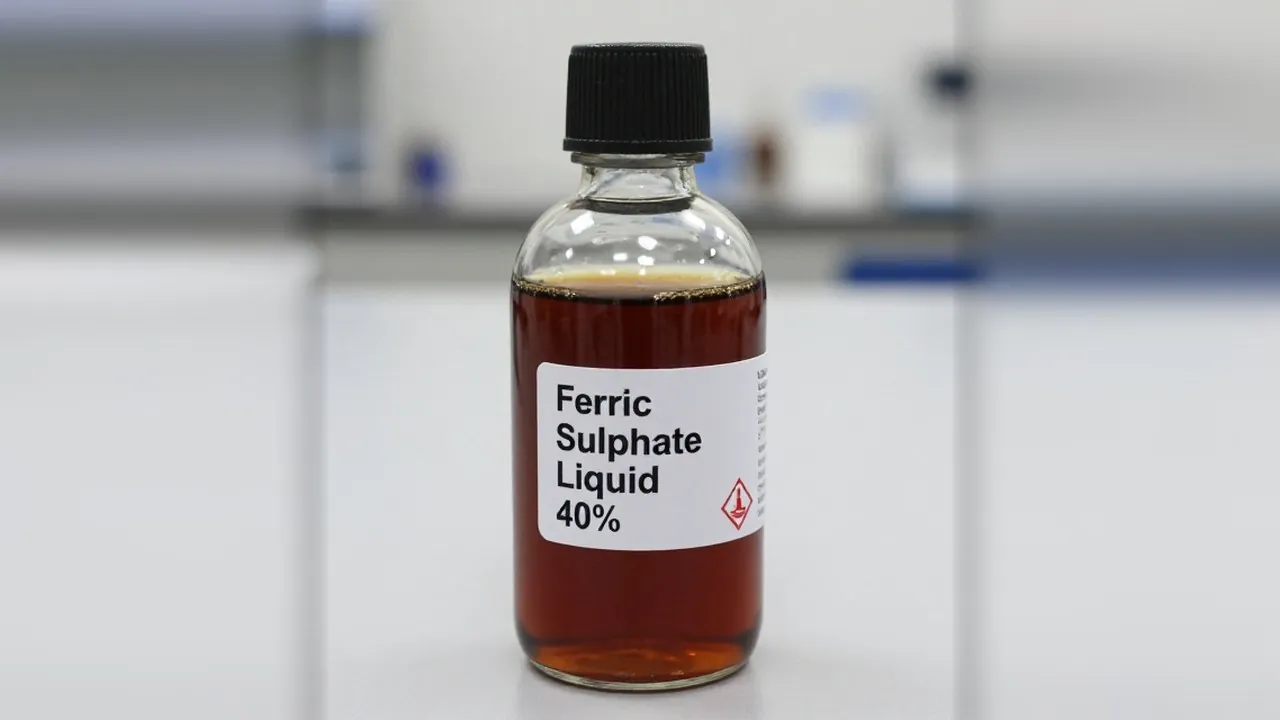
Short answer: both are iron(III) coagulants that clarify water and remove phosphate. Choose ferric sulphate when you want to avoid adding chloride and reduce corrosion on equipment; choose ferric chloride when you want the strongest, fastest-acting iron coagulant and chloride in the treated water is not a concern. The final choice should always be confirmed by a jar test on your own water.
Side-by-side comparison
| Ferric sulphate | Ferric chloride | |
|---|---|---|
| Formula / CAS | Fe₂(SO₄)₃ · 10028-22-5 | FeCl₃ · 7705-08-0 |
| Adds to treated water | Sulphate (no chloride) | Chloride |
| Corrosivity | Acidic, but less corrosive to steel | Highly corrosive; needs resistant materials |
| Coagulation strength | Strong; effective over a wide pH range | Very strong; often faster per dose |
| Phosphate removal | Effective | Very effective |
| Sludge conditioning | Good | Very good |
| Kranti grades | Liquid 40–44% · powder 65–80% | Liquid · powder |
| Transport | See SDS for the grade supplied | Liquid: UN2582, Class 8 |
When ferric sulphate is the better choice
- Chloride matters downstream — water reuse, boiler or cooling make-up, stainless-steel systems, or discharge limits on chloride.
- Equipment life — dosing pumps, pipework and tanks see less corrosion than with ferric chloride.
- Municipal and industrial wastewater — reliable clarification and phosphate removal, with iron flocs that also help sludge thickening.
- Export and remote sites — ferric sulphate powder carries no water, so it cuts freight per kilogram of active iron.
When ferric chloride is the better choice
- Very high turbidity or colour where the fastest, strongest coagulation is needed.
- Sludge dewatering and conditioning, where ferric chloride is widely used.
- Non-water uses such as PCB and metal etching, where only ferric chloride does the job.
Handling and storage
Both products are acidic solutions in liquid form, so storage tanks, pumps and lines must be acid-resistant (HDPE, FRP or lined steel). Ferric chloride is the more aggressive of the two. Always follow the SDS for the specific grade, use suitable PPE, and keep the product away from alkalis and incompatible metals.
How to decide: run a jar test
- Prepare both coagulants to a known strength.
- Dose a set of beakers of your raw water or wastewater at increasing rates.
- Rapid-mix for about a minute, slow-mix for 10–20 minutes, then settle.
- Compare clarity, residual phosphate, final pH and sludge volume.
- Price the winning dose per cubic metre treated — not the price per kilogram.
Kranti Chemicals supplies both coagulants from Gujarat, India, with a batch COA on every shipment and samples for jar testing. Request samples or a quote, or compare all four common coagulants in choosing a water treatment coagulant.